
sName2Date Lite
Reads the date from the file name – more than a dozen notations, month names in the app's language and in English
Takes the date from the file name and writes it into a photo or video as the capture date – so your photo library and File Explorer sort it correctly. One file per run, free, everything undoable with Ctrl+Z.
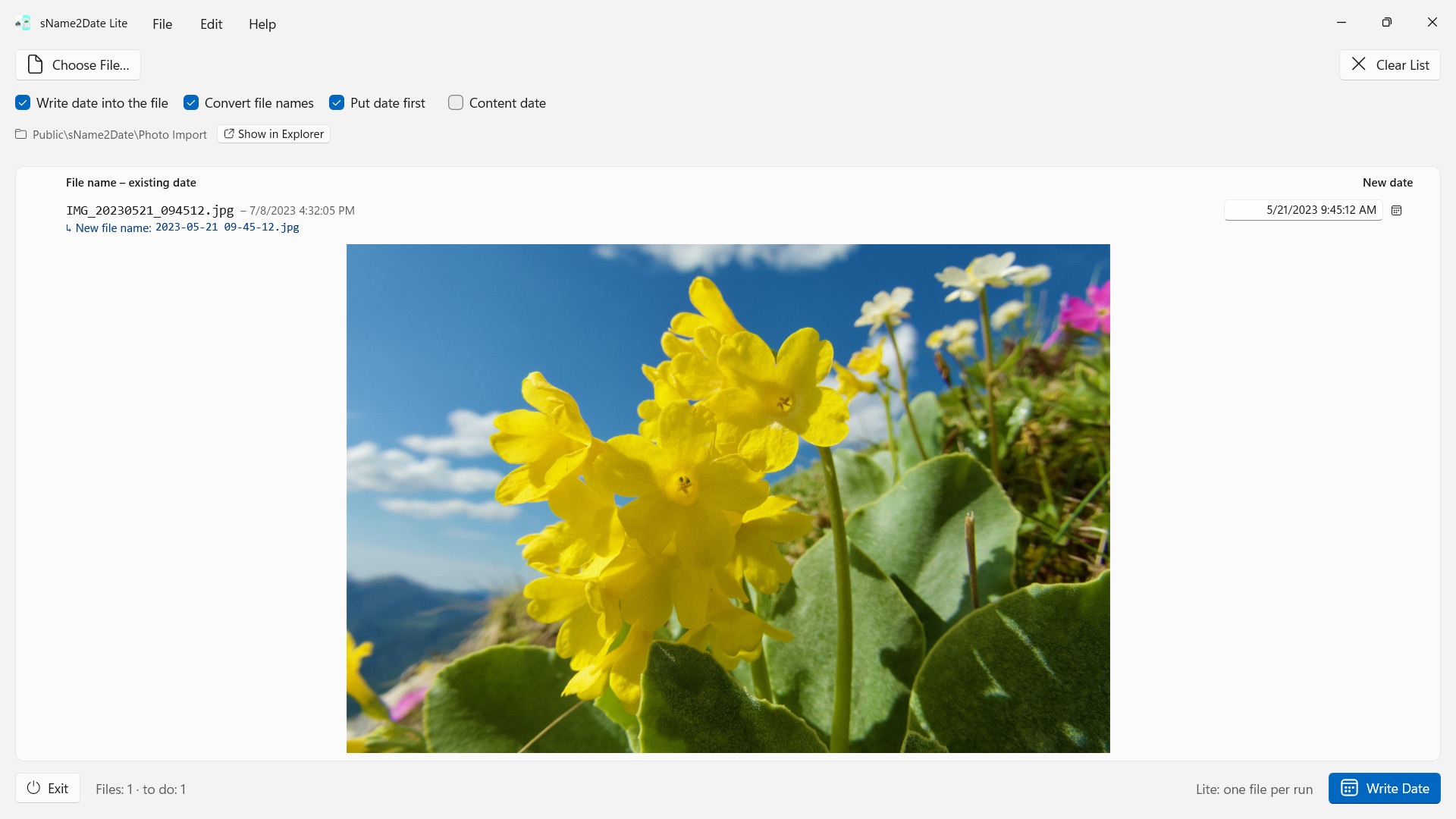
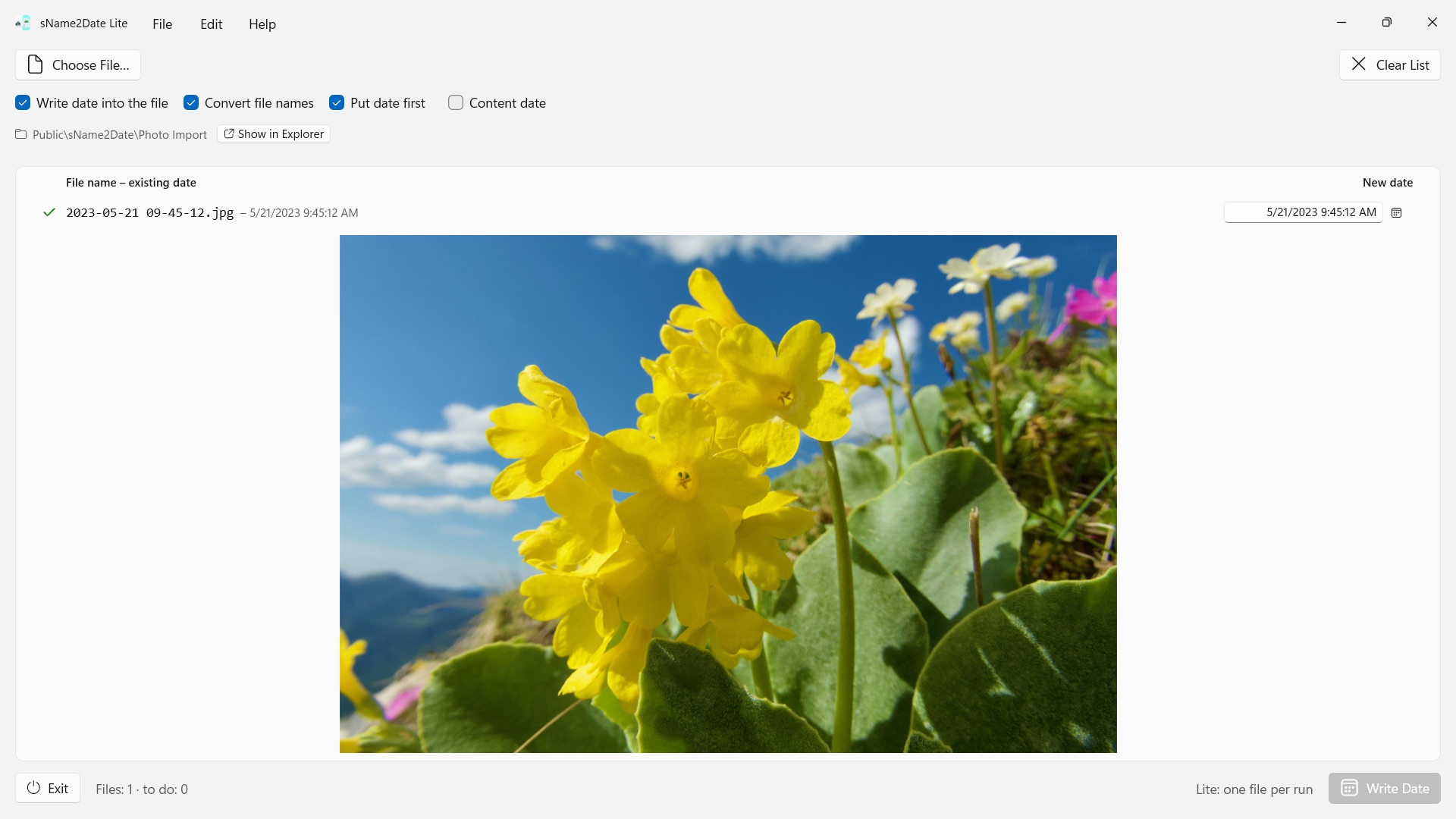
Plenty of photos and videos carry their date in the file name, and so do audio recordings and documents such as PDFs – just not where software looks for it. A picture saved from a chat, pulled off a scanner or rescued from an old archive arrives as IMG_20240115_103000.jpg, Vacation 15.01.2024.jpg or Invoice 23112024.pdf, and every photo library – and File Explorer – files it under today's date.
sName2Date Lite reads the date from the file name and writes it into the file as the capture date. If the file has none yet, it gets one. For PDFs and other files without a capture date, the app sets the file's creation and modification date. This edition takes one file per run – and can do everything with it.
25 languages: English, German, Czech, Croatian, Dutch, Finnish, French, Hungarian, Italian, Japanese, Korean, Norwegian (Bokmål), Persian, Polish, Portuguese (Brazil and Portugal), Romanian, Russian, Spanish, Swedish, Thai, Turkish, Ukrainian, Chinese (Simplified and Traditional). The app follows the Windows display language.
FORMATS IT RECOGNIZES
Dates and times in the common notations, among them:
- 2024-01-15 10-30-00
- IMG_20240115_103000
- IMG-20240115-WA0001
- 2024-01-15 · 2024 01 15 · 2024_01_15
- 15.01.2024 · 15-01-2024 · 15.01.24 · 15012024
- 15 Jan 2024 · 15 March 2024 · January 15 2024
- 2016 04 · 04-2016 – year and month only
Spelled-out month names are read in the app's language and in English, in both the long and the abbreviated form.
If the name holds only a date, a time is assumed – you decide which one. If the day is missing too, the first of the month applies, and the row says so. If several dates appear in one name, the first one wins. And where day and month could be swapped, you decide – the default comes from the Windows regional format, and the file is marked instead of being guessed at silently.
If there is no date in the name at all, you type it in yourself on the right of the row. That reaches back to 1826, the year of the oldest surviving photograph – so a scanned nineteenth-century picture can be dated just like yesterday's.
WHAT GETS CHANGED
The app writes EXIF DateTimeOriginal and DateTimeDigitized as well as TIFF DateTime, and for videos and audio recordings the creation date inside the container. On request, the creation and modification date of the file itself as well.
The image data stays untouched: a JPEG is not recompressed, a video is not re-encoded. For videos and audio recordings the app usually changes just a few bytes inside the container instead of rewriting it – even a large movie is done in an instant. After writing, the app reads the date back; the color of the row tells you where it ended up.
The capture date goes into the file itself for JPEG, TIFF and HEIC (with Microsoft's HEIF Image Extensions), for the video formats MP4, MOV and M4V and for the audio formats M4A and M4B. PNG, GIF, WebP, AVI and RAW photos get an XMP sidecar file next to them, which many photo applications read as well – the row shows a blue check mark.
EVEN FILES THAT CANNOT HOLD A CAPTURE DATE
A PDF, a text file, a spreadsheet has no field for a capture date at all – and still comes into the list. The app sets the file's creation and modification date there, the only place the date can end up; the row shows it with an orange check mark instead of a green one. So here the extension does not matter – PDFs, text, spreadsheets, archives, anything.
If the file is not to be touched at all, you clear the checkbox "Write date into the file" at the top of the window; the app then only changes the name.
THE NAME ALONG WITH IT
On request, the app brings the file name into ISO notation in the same run: Vacation 15.01.2024.jpg becomes 2024-01-15 12-00-00 Vacation.jpg. Name and capture date then say the same thing.
EVERYTHING CAN BE TAKEN BACK
A run is undone completely with Ctrl+Z – capture date, file timestamps and the changed file name. Ctrl+Y restores it.
MORE AT ONCE: THE FULL VERSION sName2Date
The full version sName2Date takes a whole folder instead of a single file: it reads the folder in, with all its subfolders if you want, shows the date it found for every file and writes the whole batch in one run – a thousand shots from a trip just as well. Files that already carry a capture date it skips on request.
For a single file, this edition is all you need.
ON YOUR PC, AND ONLY THERE
No accounts, no cloud, no analytics, no ads. The app only accesses the files you give it. Full help in every language.
- Requires Windows 11 or later
- 24 languages
- Support: SwiftAppsBavaria@gmx.net
- Privacy Policy for sName2Date